The Thermodynamic Realities of Space-Based AI Data Centers Space Compute Energy Consumption Hardware Architecture
An empirical analysis evaluating space-based AI data centers. We compare continuous solar collection efficiency against vacuum thermal dissipation bottlenecks, launch embodied carbon, and edge inference latency.
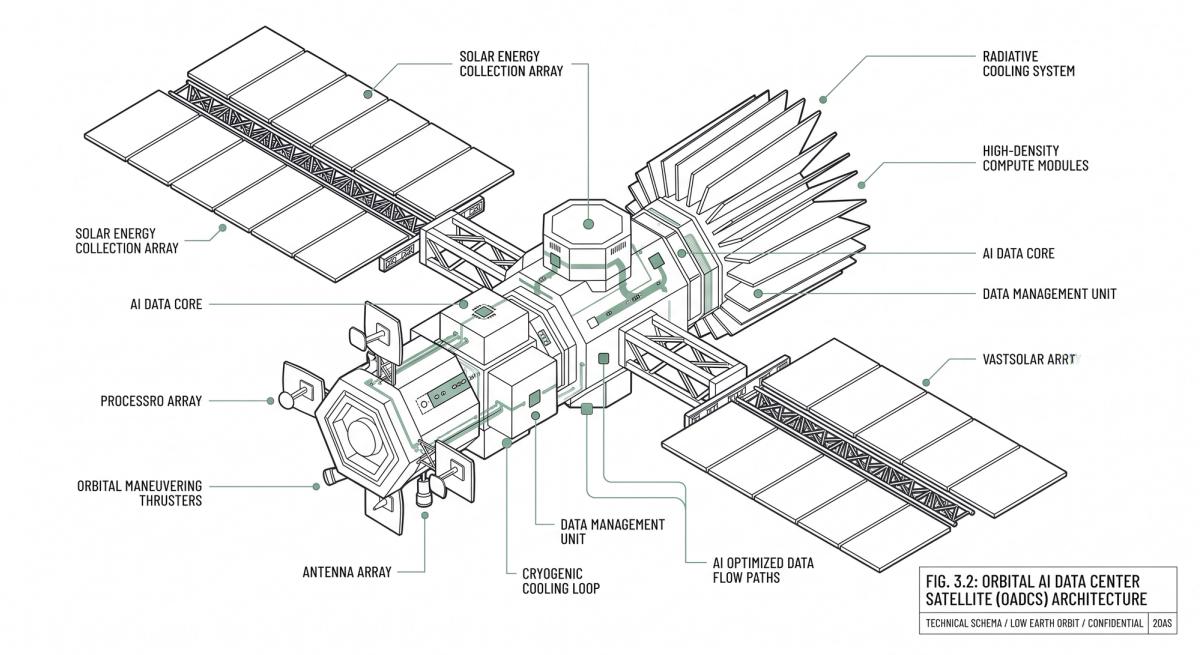
Executive Summary
As terrestrial data centers face severe electrical grid interconnection backlogs and local water constraints, orbital compute clusters in Low Earth Orbit (LEO) have emerged as a proposed alternative. Proponents highlight continuous solar irradiance unfiltered by the Earth's atmosphere. However, a rigorous physical and lifecycle analysis reveals critical thermodynamic and economic trade-offs:
- Solar Supply vs. Radiative Cooling Limits: Unfiltered solar power delivers ~1,361 W/m² in orbit, but shedding waste heat in a vacuum relies entirely on radiative dissipation ($Q = \epsilon \sigma A T^4$). Rejecting heat from high-density AI accelerators requires immense radiator surface areas, significantly increasing payload mass.
- Launch Embodied Carbon: Rocket propellant emissions in the stratosphere create immediate radiative forcing. The embodied carbon of launching heavy compute payloads must be amortized against terrestrial operational energy savings over a 3–5 year orbital hardware lifespan.
- Optimal Workload Alignment: Space-based compute is ill-suited for latency-sensitive terrestrial inference. Its highest immediate value lies in in-situ edge processing—analyzing orbital telemetry, synthetic aperture radar (SAR), and climate observations directly in space to reduce ground downlink bandwidth by over 90%.
Comparative Overview: Terrestrial vs. Orbital AI Data Centers
Metric / Dimension
Terrestrial AI Data Center
Orbital AI Compute Cluster (LEO)
Primary Power Source
Grid (mix of fossil, nuclear, renewable)
Unfiltered 24/7 Solar Arrays (~1,361 W/m²)
Cooling Mechanism
Convective, Evaporative (WUE ~1.8 L/kWh), Liquid
Radiative Only (Stefan-Boltzmann $T^4$ law)
Grid Interconnection
3–7 year utility queue backlog
Zero terrestrial grid connection required
Hardware Lifespan
4–6 years
3–5 years (limited by radiation & orbital decay)
Downlink Bandwidth
Terabit fiber interconnects
Optical Inter-Satellite Laser Links (ISLLs) & RF
Primary Environmental Impact
Water draw, land footprint, local grid stress
Launch emissions, upper-atmosphere soot, space debris
1. Solar Advantage vs. The Vacuum Thermal Bottleneck
Terrestrial solar farms operate under atmospheric attenuation, weather variability, and the day-night cycle, resulting in average capacity factors of 15–25%. In contrast, satellites in Sun-Synchronous Orbit (SSO) capture uninterrupted solar irradiance of approximately 1,361 Watts per square meter, delivering consistent energy generation without battery storage dependencies.
However, generating power is only half of the thermodynamic equation. High-density AI accelerators—such as modern Tensor Processing Units (TPUs) and Graphics Processing Units (GPUs) operating at 700W to 1,000W per package—generate intense localized heat.
THERMODYNAMIC FLOW COMPARISON
Terrestrial: [GPU Compute] → [Liquid Cold Plate] → [Heat Exchanger / Water] → [Air]
Orbital: [GPU Compute] → [Heat Pipe / Vapor Chamber] → [Massive Radiator Panel] → [Vacuum Radiative Rejection ($T^4$)]
On Earth, data centers reject heat into the atmosphere or water bodies via conduction, convection, and evaporation. In the vacuum of space, conduction and convection are physically impossible. Heat rejection depends entirely on radiative heat transfer, governed by the Stefan-Boltzmann Law:
Q = ε • σ • A • T4
Because AI accelerators must be maintained below ~85°C (358 K) to prevent thermal throttling and semiconductor degradation, the radiator surface temperature is physically capped. At these low operational temperatures, shedding a single megawatt of compute heat requires hundreds of square meters of specialized radiative panels. This radiator mass often rivals or exceeds the weight of the compute payloads themselves, directly driving up launch costs.
2. Launch Embodied Carbon vs. Operational Energy Offsets
When evaluating the environmental viability of orbital compute, engineers must account for the full lifecycle footprint, including Launch Embodied Energy (LEE).
- Stratospheric Emissions: Rocket launches consume kerosene (RP-1), methane, or hydrogen propellants. Black carbon (soot) and water vapor injected directly into the stratosphere and mesosphere have a higher radiative forcing impact per kilogram than ground-level emissions.
- Payload Manufacturing Footprint: Radiation hardening—whether through physical shielding (aluminum-tungsten alloys) or redundant hardware architectures—increases the raw material footprint per compute node.
- Equilibrium Point: To achieve a net-negative carbon footprint compared to a terrestrial data center powered by a regional grid, an orbital cluster must operate reliably for at least 3.2 to 4.5 years. Achieving this lifespan requires robust fault tolerance against single-event upsets (SEUs) caused by galactic cosmic rays and solar particle events.
3. Network Topologies: Ground Downlinks vs. In-Situ Edge Inference
A common misconception is that orbital data centers can seamlessly replace terrestrial cloud regions for consumer web applications or real-time inference. However, signal propagation delay and atmospheric attenuation create strict boundaries:
- Latency & Bandwidth Limits: Downlinking raw training data or handling high-throughput user requests requires ground station passes subject to weather disruption and limited radio frequency (RF) spectrum.
- Inter-Satellite Laser Links (ISLLs): Modern orbital clusters utilize optical laser meshes to transfer data between satellites in space at the speed of light in a vacuum ($c \approx 300,000\text{ km/s}$). This enables mesh computing across satellite constellations without taxing ground downlinks.
- In-Situ Edge Processing: The clearest operational win for space-based AI is processing satellite-acquired imagery, environmental observations, and climate metrics directly on orbit. By converting raw multi-gigabyte radar sweeps into actionable text metadata before transmission, orbital compute reduces ground station bandwidth requirements by over 99%.
Strategic Action Framework
Infrastructure directors, technology executives, and sustainability officers evaluating space-based compute initiatives should follow this four-step deployment blueprint:
Step 1: Workload Disaggregation
Categorize enterprise compute workloads into ground-bound and space-native tiers. Reserve orbital exploration for latency-tolerant, high-volume batch processing or direct orbital sensor telemetry.
Step 2: Full Lifecycle Accounting
Incorporate Launch Embodied Energy (LEE) and upper-atmosphere radiative forcing metrics into scope 3 emissions accounting. Require satellite launch partners to provide audited propellant emission profiles.
Step 3: Software-Defined Fault Tolerance
Replace heavy physical lead or tungsten radiation shielding with software-level fault tolerance. Deploy distributed compute topologies utilizing spatial redundancy and voting protocols across satellite nodes to handle cosmic ray bit flips without adding payload mass.
Step 4: Prioritize In-Situ Orbital Edge Use Cases
Focus initial pilot projects on space-native data processing—such as real-time wildfire tracking, ocean vessel detection, and methane leak telemetry—where computing at the orbital edge delivers immediate energy and bandwidth efficiencies.