Texas Data Center Boom Could Erase Decades of Air Quality Progress, New Report Warns
A new Houston Advanced Research Center report finds Texas's data center build-out could push air pollution back toward 2000s-era levels, depending on how facilities are powered.
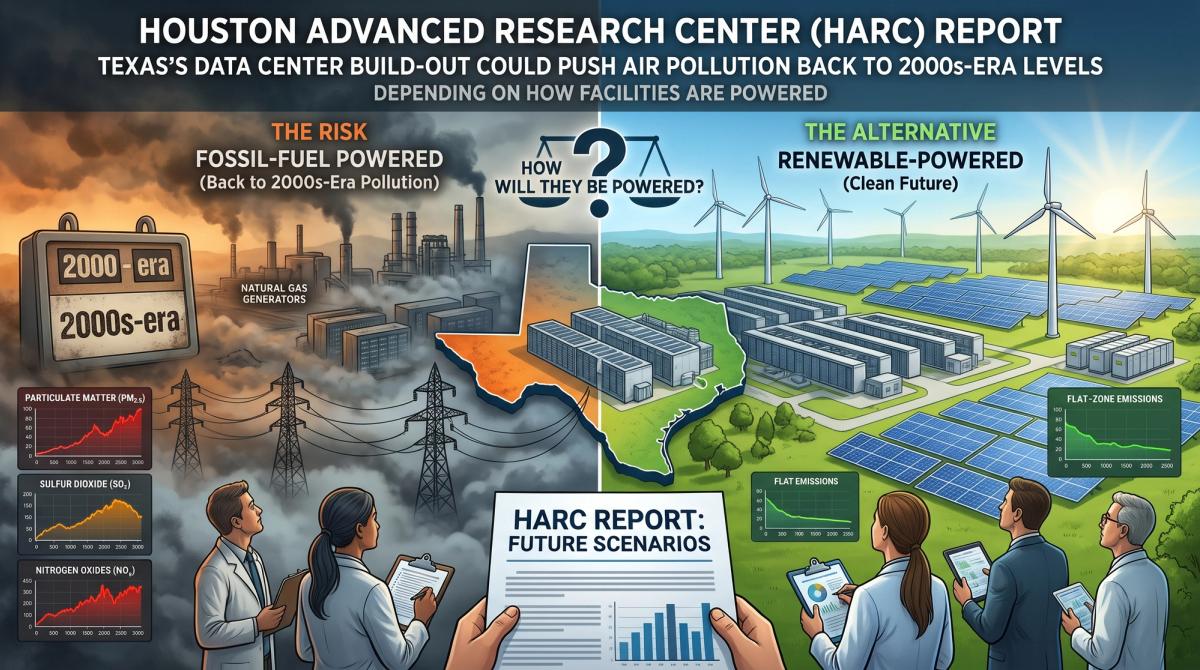
A new report from the Houston Advanced Research Center, released this week and covered by The Texas Tribune, finds that Texas's data center boom could erase much of the state's two-decade run of air quality gains. The outcome depends heavily on how new facilities get their power. Under a scenario where data centers lean on grid electricity plus on-site wind and solar, nitrogen oxide emissions could still climb 35% by 2031. If developers instead turn to on-site natural gas generation, the report projects NOx emissions could rise nearly 400%, with particulate matter reaching levels not seen since 2006.
The scale driving these projections is striking: at least 288 data center projects are planned statewide, alongside 32 proposed natural gas plants, more than any other state. ERCOT logged over 500 large-load connection requests in the past two years, up from roughly two dozen the year before. Because grid interconnection queues can run three to five years, many developers are turning to on-site gas generation in the meantime, which emits roughly four times the NOx of an equivalent draw from the grid. Texas Gov. Greg Abbott has temporarily paused new data center grid connections pending an audit, and HARC recommends treating data centers as industrial facilities subject to standard emissions rules, with mandatory disclosure of power use and pollution.
This is exactly the gap AI for Ecology exists to close. The report's own recommendation, standardized, comparable disclosure of power source and emissions, is a specification problem before it's a policy one. Without open, consistent benchmarks for how a given AI workload is powered and how much it emits, operators, regulators, and the public are left arguing over which scenario is real. We see this as a concrete case for the kind of open measurement and certification infrastructure we build toward: if every data center reported power mix and emissions against a shared, auditable standard, communities and regulators could tell the difference between an operator genuinely pursuing clean power and one quietly defaulting to diesel and gas on-site generation while the grid queue clears.
Source: The Texas Tribune