SpaceX Wins FCC Approval to Build a Million-Satellite AI Data Center Network
The FCC approved SpaceX's Starmind network of up to 1 million orbital AI satellites. AIforE's take: solar power beyond the grid still needs the same open lifecycle accounting as any data center on the ground.
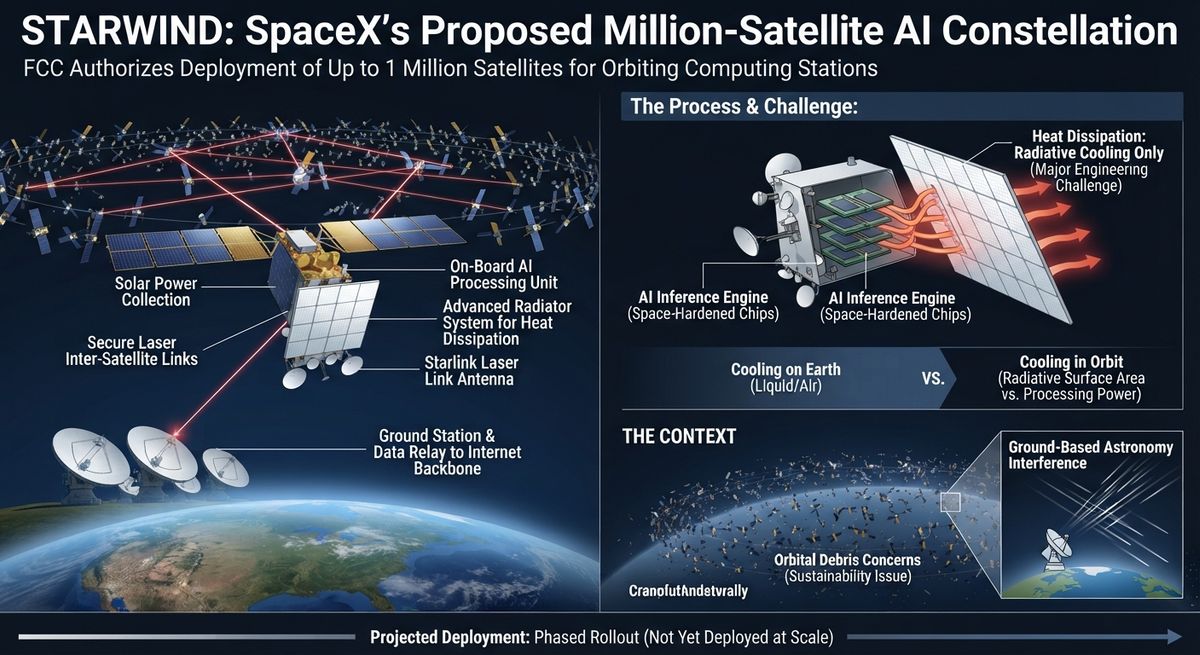
The Federal Communications Commission has authorized SpaceX to deploy as many as one million satellites for Starmind, a proposed network of orbiting computing stations designed to run AI workloads in low Earth orbit. The plan calls for satellites equipped with solar panels and AI chips to process data in space and relay results to Earth over laser links tied into the Starlink network, with chips produced at a dedicated SpaceX facility. The authorization covers a potential buildout; no satellites have been deployed at that scale yet.
The pitch is straightforward: a data center that draws power directly from the sun, without pulling electricity off a terrestrial grid or drawing down a municipal water supply for cooling. But scientists and engineers have already raised pointed questions about whether the physics holds up. On the ground, fans, chillers, and water loops carry heat away from racks of AI chips; in the vacuum of space, a satellite can only shed heat by radiating it outward, a far less efficient process that may demand enormous radiator surfaces relative to the computing power onboard. Orbital debris and interference with ground-based astronomy add further open questions.
AIforE's take: orbital computing is a useful reminder that "green" claims need the same independent scrutiny wherever the hardware sits. A satellite data center may someday sidestep the grid and the water table, but it still carries an energy and materials footprint of its own - launch emissions, satellite manufacturing, and eventual orbital debris - that deserves the same rigorous lifecycle accounting AIforE is building for data centers on the ground. Moving infrastructure off the planet doesn't move it outside the need for measurements.
Source: The Neuron