OpenAI's 1,000-Megawatt Pledge Puts Data-Center Demand Response to the Test
OpenAI committed 1,000 MW of a planned Georgia campus to grid curtailment, citing a UK trial that cut AI compute power 40% in seconds. The real test ahead: open benchmarks for claims like these.
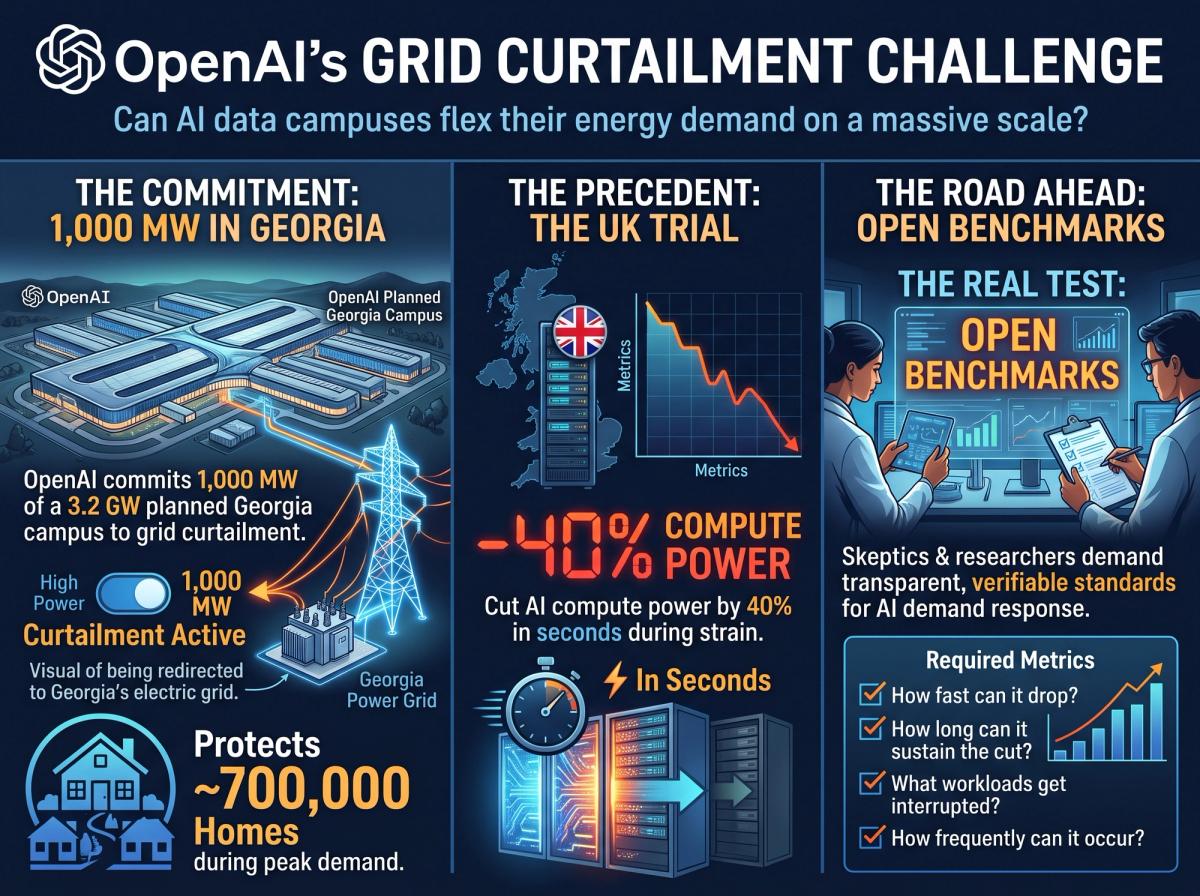
OpenAI this week launched its Grid Protectors Program, committing to build electricity curtailment into the compute campuses it develops directly. The pilot is Project Camellia, a planned 3,200-megawatt campus in Effingham County, Georgia, built under a 25-year power agreement with Georgia Power. OpenAI says it will make 1,000 megawatts — about 31% of the campus's peak load — available to shed during extreme weather or regional demand spikes.
The commitment follows a controlled trial that UK grid operator National Grid ran with Emerald AI, research consortium EPRI, cloud provider Nebius, and NVIDIA. Over five days simulating more than 200 grid emergencies at a London-area GPU cluster, power draw fell by up to 40% with full compliance; in the fastest case, the cluster shed 30% of its load in under 40 seconds, and it sustained a 10% cut for ten straight hours without disrupting live inference workloads. Georgia Power calls the resulting pledge one of the largest single-facility demand response commitments in the country — and OpenAI itself is careful to note that flexibility is a complement to, not a substitute for, new energy supply and transmission.
This is precisely the kind of claim AIforE exists to stress-test. A "40% cut, 100% compliance" figure from a single simulated trial, folded into a bilateral deal between one company and one utility, isn't independently verified and isn't comparable to any other operator's flexibility commitment — because no open standard yet defines how curtailment capacity, response speed, or compliance should be measured or audited. As AI load flexibility becomes a real grid-reliability tool, the industry needs open benchmarks and certification that let regulators, utilities, and the public check these numbers themselves, rather than taking one company's pilot as the template for everyone else's.
Source: Tech Times