Nebraska's First Data Center Disclosures Show What AI's Footprint Actually Looks Like
Six Nebraska data centers just filed the state's first mandatory water and power report. The numbers offer a rare, comparable glimpse of AI infrastructure's footprint and a preview of what broader transparency standards could look like.
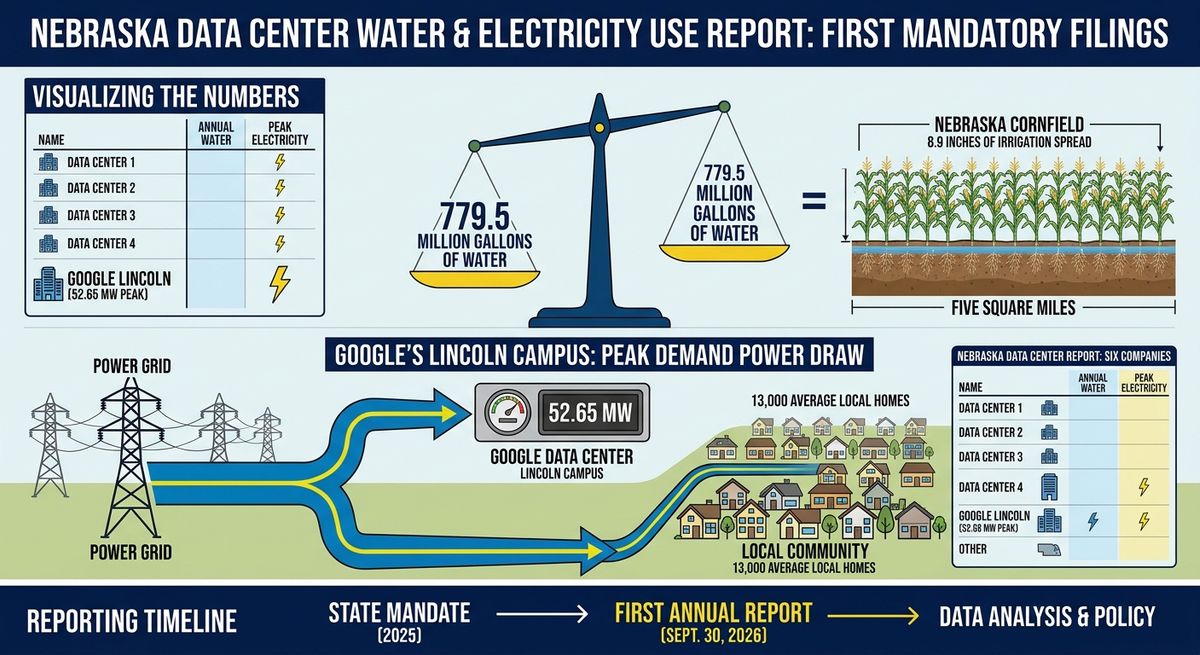
At the end of September, six Nebraska data centers filed the state's first mandatory report on their water and electricity use, among them a Google facility in Lincoln. Local reporters at 10/11 News asked a University of Nebraska-Lincoln geologist and an energy consultant to translate the raw numbers into something legible: a combined 779.5 million gallons of water, equivalent to roughly 8.9 inches of irrigation spread across five square miles, about what a section of Nebraska corn needs in a dry year. At peak demand, Google's Lincoln campus alone drew as much power as about 13,000 average local homes.
The context mattered as much as the figures. The geologist found no sign that the facilities are drawing down the Ogallala aquifer; their cooling water comes from the municipal supply, and none had applied for high-capacity water permits as of mid-September. The local utility said Google pays a special rate that keeps its costs off residential bills, and it attributed recent rate increases mainly to drought and inflation rather than the new data center load.
What stands out to us isn't the scale of the numbers so much as the fact that they exist at all, in a usable, comparable form. Most AI infrastructure operators still disclose efficiency metrics voluntarily, in their own formats, on their own schedule, with no independent verification. Nebraska's law produced six facilities' worth of consistent, site-level water and power data in a single reporting cycle, a small but concrete demonstration of what open, standardized disclosure could look like at scale. That's the direction we want the whole sector to move: shared specifications and independent benchmarks for reporting AI's resource footprint, so a story like this one doesn't depend on a single state law and a handful of curious local reporters.
Source: 10/11 News (KOLN, Lincoln, NE)