Microsoft Delays UK AI Supercomputer Plan due to Power Grid Inadequacy
Microsoft pulled funding for a $2.7B UK supercomputer after learning grid power won't reach the site until the 2030s — a sharp reminder that AI's energy appetite is now a hard infrastructure limit.
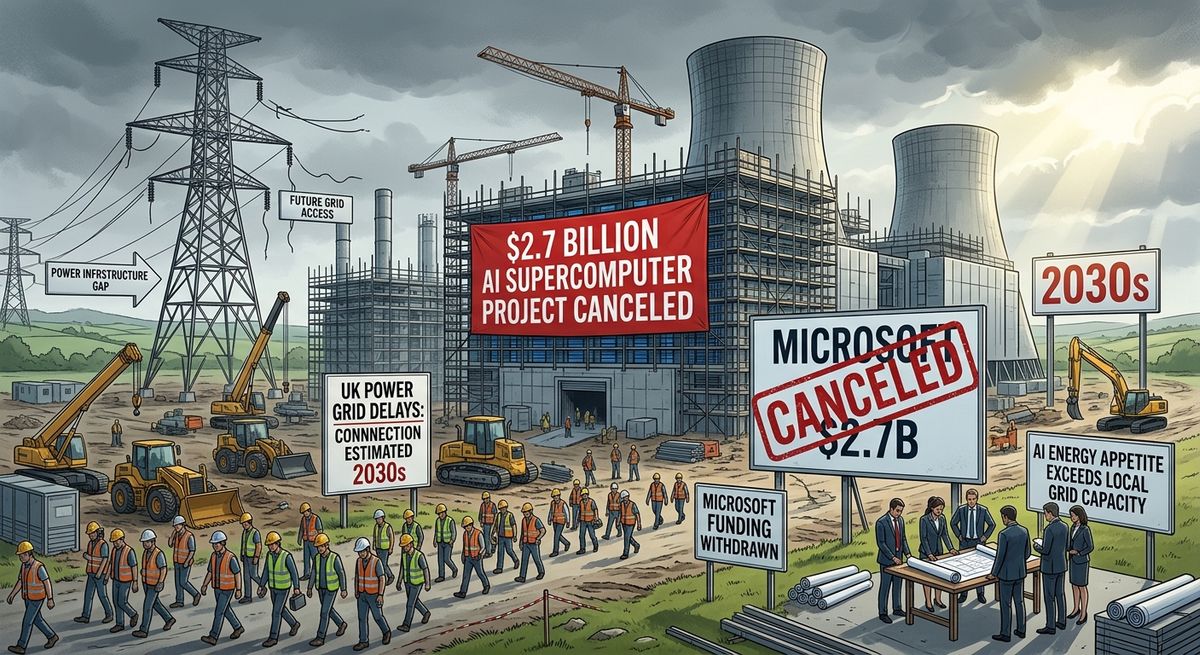
Microsoft has ended its plan to fund a supercomputer at Nscale's AI data center in Loughton, England — a roughly $2.7 billion facility that was set to become the UK's largest, housing more than 23,000 Nvidia chips. The BBC reported the pullback on October 18, and the Telegraph reported the reason: Nscale was told the site won't receive a grid connection until the 2030s. Microsoft said the decision "relates to a single site" and that its broader partnership with Nscale, which also spans projects in the US, Norway, and Portugal, remains intact.
The project was unveiled in September 2025 as part of Microsoft's $30 billion UK AI investment pledge, with vice chair Brad Smith explicitly linking its scale to the UK government's push to reform planning rules and expand electricity capacity. More than a year later, that bet on faster grid buildout hasn't paid off — and Loughton isn't an isolated case. A Rocky Mountain Institute analysis found that projects seeking to connect to the US PJM grid now wait more than eight years on average, a sign that interconnection, not chips, is becoming the binding constraint on AI infrastructure on both sides of the Atlantic.
For AI for Ecology, this is the story behind the headlines we keep returning to: the grid, not the GPU, is where AI's environmental and infrastructure reality gets decided. When a flagship project this size stalls purely on interconnection timelines, it's a reminder that siting and energy claims from AI developers need to be verifiable against open, independent data — not announced and taken on faith. That's the gap our work on open specifications and benchmarking for data center energy and siting claims is built to close.
Source: Daily Caller