In 15 Countries, Residents Push Back on the Data Center Boom
Over 100 groups across 15 European countries protested Nov. 6-7 for a moratorium on new data centers, citing energy, water, and grid strain.
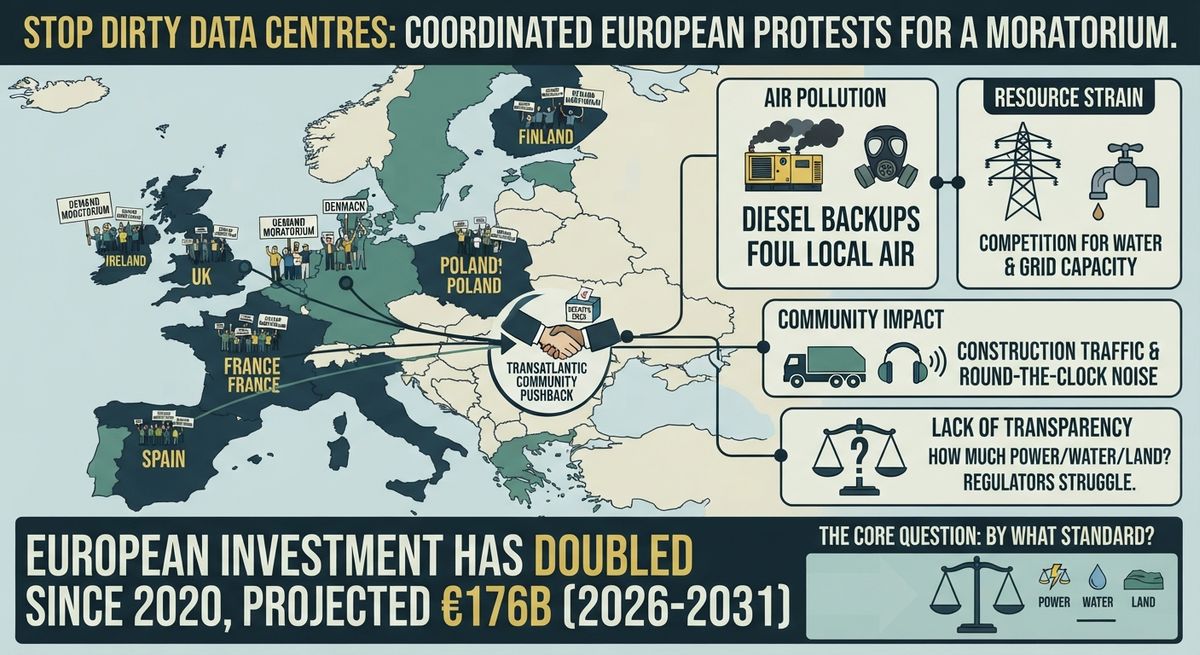
This past weekend, more than 100 civil society groups across 15 European countries held coordinated protests calling for an immediate moratorium on new large-scale data centers. Organized under the Stop Dirty Data Centres campaign, actions took place in Ireland, Spain, Poland, Denmark, Finland, France, the Netherlands, and the UK — ranging from public meetings and petitions to walking tours past proposed construction sites. The timing was pointed: organizers noted that data centers became a decisive issue in the recent U.S. midterm elections, a sign that community pushback on AI infrastructure is no longer a niche concern on either side of the Atlantic.
The complaints are specific and recurring: diesel backup generators fouling local air, heavy construction traffic, round-the-clock equipment noise, and competition for scarce water and grid capacity. European data center investment has roughly doubled since 2020, en route to an estimated €176 billion in spending between 2026 and 2031, according to PwC projections. Communities are increasingly asking a question regulators have struggled to answer: how much power, water, and land will a given facility actually use, and against what standard should that be judged?
That question is exactly the gap AI for Ecology exists to close. Protest and moratorium are blunt instruments — they buy time, but they don't tell a planning board or a utility regulator what "sustainable" actually means for a specific project. Open specifications for disclosing energy mix, water draw, and compute efficiency, paired with independent benchmarks and a certification communities and regulators can point to, turn a shouting match into a checklist. We'd rather see data centers compete on a published efficiency score than fight it out site by site in city council meetings.
Source: Euronews