Google's $4.3 Billion Deal for Nuclear Energy Powered AI Data Centers
Google and Constellation Energy struck a 20-year deal bringing 890 MW of new nuclear capacity to the grid, part of a $4.3B plant upgrade — alongside a separate deal to run grid operations on Google's own AI.
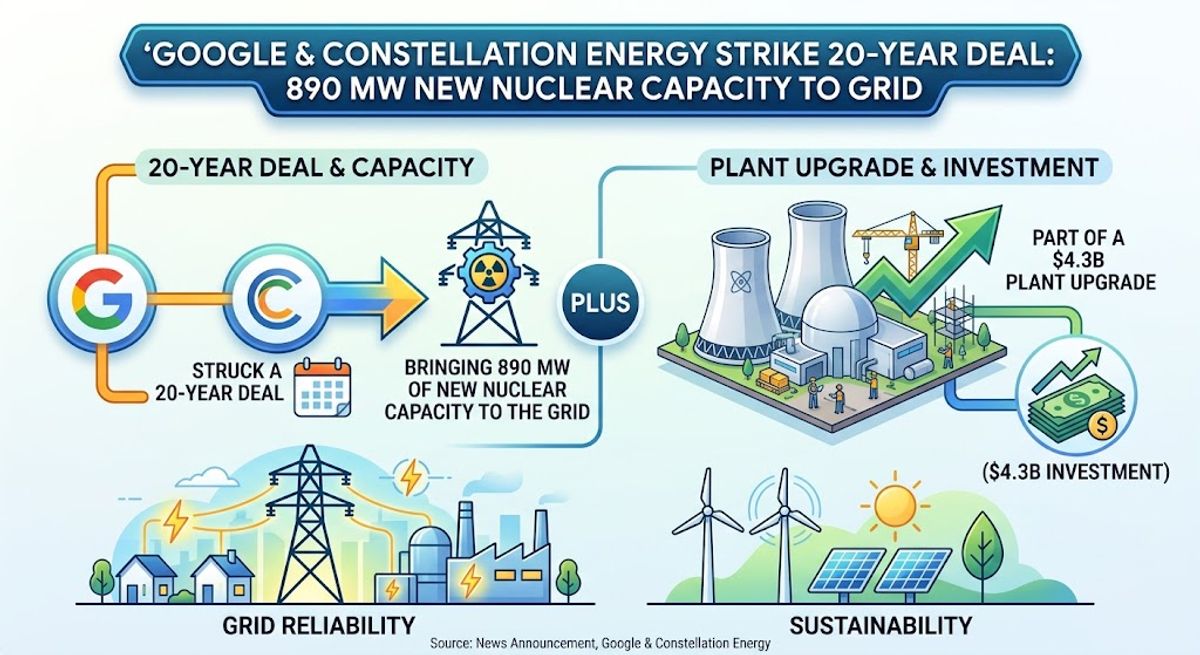
Google and Constellation Energy signed a 20-year power purchase agreement on October 6 that the companies are calling a "clean energy partnership." Constellation will spend more than $4.3 billion upgrading 11 nuclear units across six plants in Illinois, New Jersey, and Pennsylvania, bringing 890 megawatts of new capacity onto the PJM grid, which serves 13 Mid-Atlantic and Midwest states. A separate 15-year agreement locks in another 2,700 megawatts from Constellation's existing fleet. Google says the deal sustains 4,400 existing operating jobs and creates roughly 7,200 construction jobs during the upgrade.
A second, smaller deal got less attention in the coverage: Constellation also signed a five-year contract to run its plant site selection, outage management, and generator dispatch on Google Cloud's Gemini Enterprise platform. So the company buying the power is also the company supplying the AI that helps decide how the plants are operated.
Bringing existing reactors back online is a genuinely better path than building new gas peaker plants to feed AI demand, and Google is right that it's often the fastest new megawatt available. But "clean energy partnership" is a label, not a measurement — the announcement includes no emissions accounting, no breakdown of how much of that 890 MW is truly incremental versus reallocated from other buyers, and no detail on whether the Gemini-run grid software itself is auditable by anyone outside the two companies. That's the same gap AI for Ecology's open benchmarks and certification work is meant to close: a common, independently checkable way to verify what a utility and a hyperscaler mean when they call a power deal "clean," instead of taking the press release at its word.
Source: SiliconANGLE