Google Signs Its First Superhot Geothermal Deal to Power Oregon Data Centers
Google will buy 50 MW from Quaise Energy's Project Obsidian in central Oregon, a plant that aims to reach superhot rock with a beam that vaporizes stone. First power is slated for 2030.
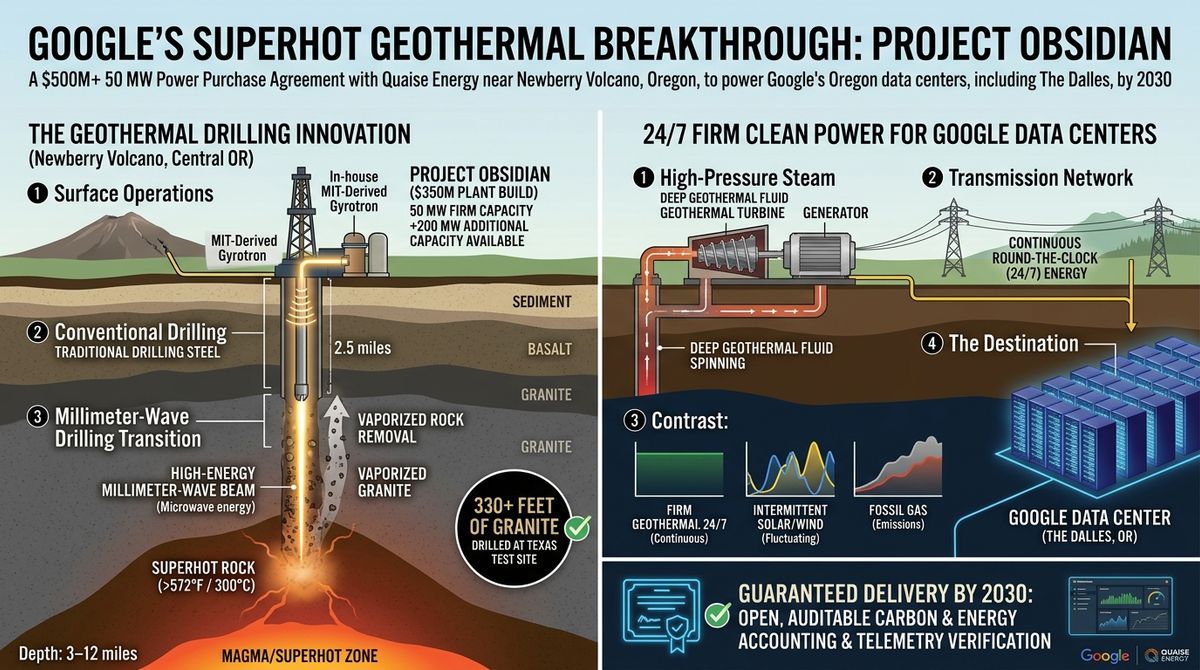
Google has agreed to buy 50 megawatts of round-the-clock power from Quaise Energy's first commercial plant, Project Obsidian, near Newberry Volcano in central Oregon. The power purchase agreement — a long-term contract to buy a plant's output — is valued at more than $500 million, according to Quaise. Google plans to use the electricity for its Oregon data center operations, including The Dalles, with delivery as early as 2030. The plant is expected to cost about $350 million to build, and Quaise is looking for buyers for another 200 MW at the site.
What sets the project apart is how it gets to the heat. Quaise targets superhot rock above 572°F (300°C), several miles down, where each well can carry far more energy than conventional geothermal. It plans to drill conventionally to about 2.5 miles, then switch to millimeter-wave drilling: a gyrotron, essentially a giant microwave born from MIT fusion research, beams energy down the borehole and vaporizes the rock instead of grinding through it. The method is still being proven — Quaise has drilled more than 330 feet of granite at its Texas test site — so the first phase leans on conventional rigs, with the beam retrofitted onto existing equipment later.
For data centers, the appeal is firm clean power: electricity that runs day and night, unlike solar or wind, without burning gas. The deal also shows how hyperscalers are now underwriting early-stage energy technology years before it produces a kilowatt-hour. That makes measurement matter. When a contract promises carbon-free power in 2030, operators, regulators and communities will need a shared, verifiable way to confirm what each facility actually draws and emits once the plant is online — the open, auditable accounting that AIforE's standards and telemetry work is designed to provide.
Sources: The Wall Street Journal; Canary Media