Goldman Sachs: Power, Not Chips, Is Becoming AI's Real Constraint
A new Goldman Sachs report argues grid capacity, not model capability, is now the binding constraint on AI's growth, with a median five-year wait for new power connections.
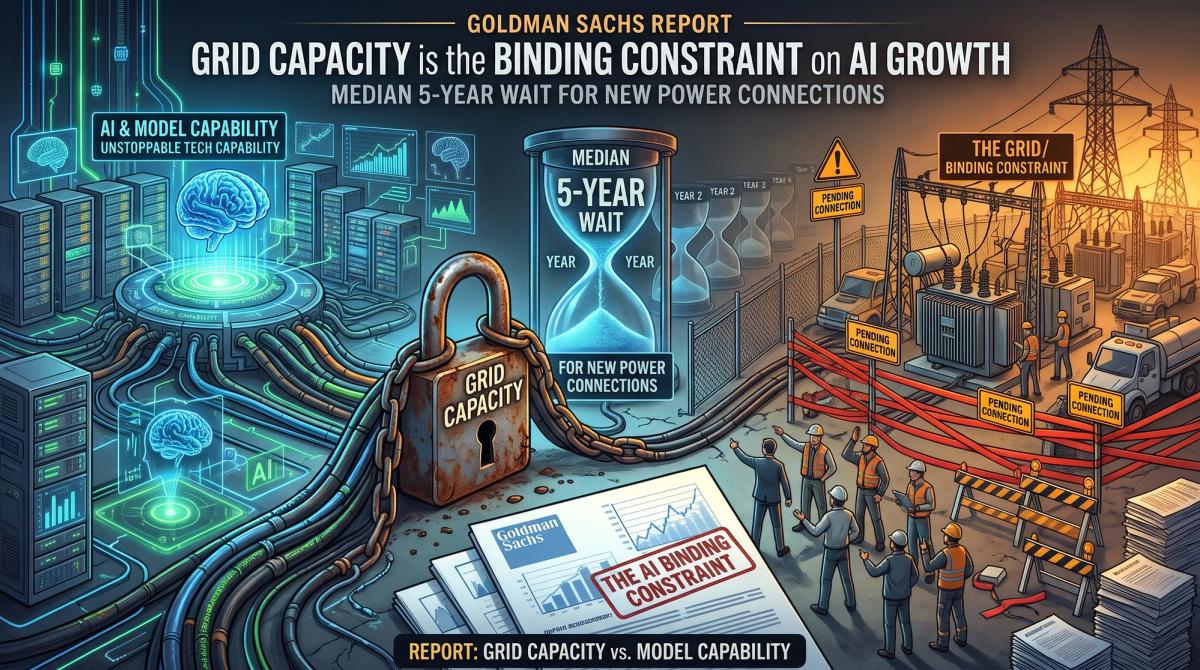
A Goldman Sachs report out this week, "Navigating a system of AI bottlenecks" and reported by Axios, makes a blunt case: the limiting factor on AI's expansion is no longer frontier model capability, it's electricity. Global data center power demand is projected to rise 170% between 2025 and 2030, with more than 60% of that growth concentrated in the U.S. Roughly $7.6 trillion in capital spending is projected across computing, data centers, and power generation between 2026 and 2031. Meanwhile, the U.S. has about 2,600 gigawatts of proposed generation and storage projects stuck in interconnection queues, more than double the grid's existing installed capacity, with a median wait of about five years from application to commercial operation.
Goldman's Jason Tofsky put it plainly: "Power is probably the forever bottleneck." The report also flags financing strain, with hyperscaler debt issuance projected to jump more than 60% to $420 billion in 2027, and a wave of friction on the ground: 86 projects have been canceled or significantly delayed since January, 76 of them due to local opposition. Utilities, for their part, are planning $1.3 trillion in capital spending through 2030 to try to keep pace.
When electricity itself is the scarce resource, efficiency per unit of useful compute stops being a sustainability footnote and becomes the determining factor in who actually gets to build. That's precisely the terrain AI for Ecology is working to equip people for: open efficiency benchmarks and certification that let regulators, utilities, and communities tell a genuinely efficient AI deployment from a wasteful one, rather than taking a developer's word for it. As grid capacity becomes the thing everyone is fighting over, we think the organizations able to prove, credibly and transparently, that their compute is lean will be the ones best positioned to keep building, and the ones worth prioritizing for scarce interconnection capacity in the first place.
Source: Axios