Goldman Sachs: AI's Growth Is Now a Power Problem, Not a Chip Problem
Goldman Sachs: the AI race now hinges on electricity, not chips. Grid delays have already stalled 86 data center projects — and investors are taking note.
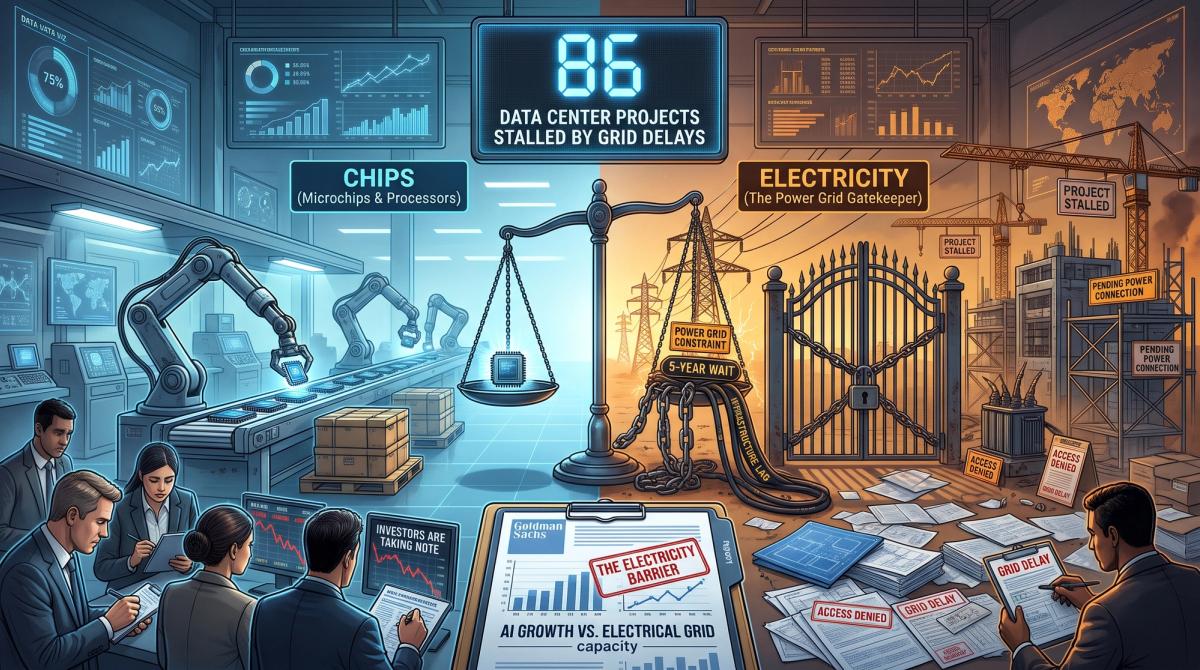
Goldman Sachs analysts say the real constraint on AI's expansion has shifted from chip supply to electricity supply. In a note this week, the bank's digital infrastructure team argued that securing power, not compute, now determines who wins the AI race. Global data center power demand is projected to rise 170% between 2025 and 2030, with the U.S. absorbing more than 60% of that growth.
The bottleneck is already visible: roughly 2,600 gigawatts of proposed generation and storage projects are stuck waiting for grid connections — more than double the grid's current installed capacity — and the typical wait from application to operation runs about five years. Since January, 86 planned data center projects have been canceled or delayed, most of them over local opposition. Goldman still expects hyperscalers to issue $420 billion in debt in 2027 to keep building anyway.
For AI for Ecology, this is the story behind the story. Every gigawatt of "AI growth" is also a line item in a community's water table, emissions inventory, and electricity bill — numbers that are rarely reported the same way twice. We build open specifications and benchmarks precisely so a data center's power and environmental footprint can be measured, compared, and certified consistently, rather than estimated after the fact by a bank's research desk. The sooner that information is standardized and public, the sooner communities, regulators, and investors can tell a responsibly built AI buildout from a reckless one.
Source: Axios