Cooks River Was a Warning, Not a Verdict
Sydney residents stopped an AI data centre on the Cooks River. The lesson isn't that people reject AI. It's that they reject being left out, and there's a better way to build.

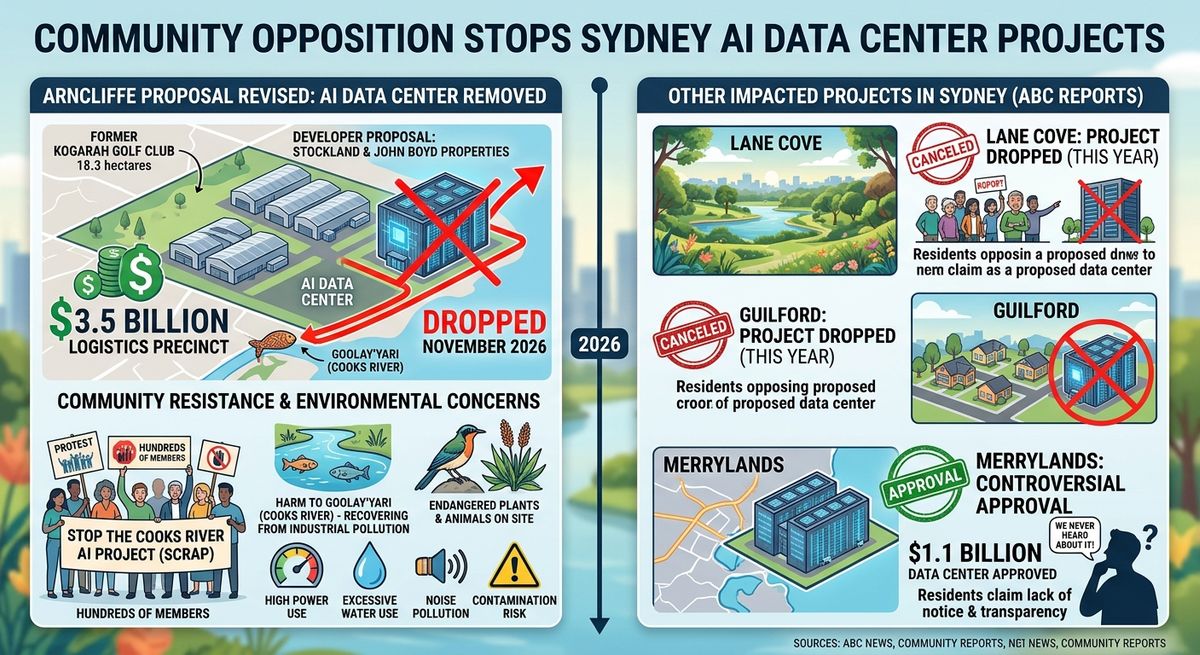
The AI data centre planned for the Cooks River in Sydney is off the table. Residents organised, spoke up and won. At AIforE, we think they were right to fight, and we think the lesson reaches far beyond Sydney.
AI is here to stay, and so are the data centres that power it. The question was never whether they get built. It is whether they are built for the places they land or despite them. Cooks River shows what happens when a community feels it is the second.
What happened at Cooks River
Developers Stockland and John Boyd Properties had proposed turning the former Kogarah Golf Club site at Arncliffe, about 18.3 hectares, into a logistics precinct worth an estimated $3.5 billion, with an AI data centre as part of it. In November 2026 they dropped the data centre and said the revised masterplan would go ahead without one (ABC News).
The change followed months of opposition from Stop the Cooks River AI Project (SCRAP), a community group with hundreds of members. Residents feared harm to a river that local Indigenous languages call Goolay'yari, which has been slowly recovering from decades of industrial pollution. They pointed to endangered plants and animals on the site, and raised concerns about power use, water use, noise and possible contamination.
Cooks River is not alone. ABC reports that projects in Lane Cove and Guildford were also dropped this year, and residents in Merrylands say a $1.1 billion data centre was approved without them ever hearing about it.
The problem is the process, not AI
The backlash at Cooks River is not proof that people reject AI. It is proof that people reject being left out. When residents learn about a project late, can't see its real water and power numbers, and have no say in how it affects their river, opposition is the rational response.
That pattern costs everyone. Communities spend months organising to defend what they love. Developers lose time and money on plans that never get built. Governments end up fast-tracking projects before the rules are ready, which ABC notes was a concern raised by a recent New South Wales parliamentary inquiry. And the ecosystems at stake get no voice at all unless someone stands up for them.
A better path
There is another way to build, and it starts before the first plan is filed. Communities get real information early, in plain language, and a genuine say in where and how a facility is built. Developers commit up front to leaving the land and the people around it better off. At AIforE, we measure that commitment with the 5 Rs:
- Renewable energy: clean power first, so a data centre doesn't strain the local grid or the climate.
- Recycle heat: waste heat goes to work warming homes, greenhouses or nearby buildings.
- Recycle water: closed-loop cooling and reuse, so a facility doesn't compete with a river or a town for water.
- Remediate greenhouse gases: where clean power isn't yet practical, emissions are captured and removed.
- Restore habitats: the site and its surroundings come out healthier than before, not just protected.
Imagine Cooks River under that standard. Instead of a threat to a recovering river, a project could have helped fund its restoration, with water and power plans the community could check for themselves.
Connecting the data, from planning to operations
Most data centre conflicts start with missing or scattered information. The data that matters is spread across developers, utilities, regulators and environmental studies, and it rarely follows a project from one stage to the next. Communities see a slice of it, late. Decisions get made with half the picture.
AIforE's approach is to connect every data point across a data centre's whole life cycle:
- Planning: site options, local ecology, water sources, grid capacity and community priorities.
- Approvals: environmental assessments, permits and public input, tracked in one place.
- Construction: progress against commitments on land, water and habitat.
- Operations: ongoing energy, water, heat, emissions and restoration results, measured against the 5 Rs.
That connected data is made available for analysis by everyone with a stake: developers, operators, regulators and residents. AI then does what people can't do alone. It weighs thousands of variables at once and finds the solutions that best meet the goals everyone agreed on together, not just one party's bottom line.
At Cooks River, that could have meant residents seeing real water and power figures from day one, and the developers testing designs that protected the river before a single protest was needed.
Where AIforE fits
AIforE is a nonprofit that enthusiastically supports AI and wants it built sustainably, for the greatest common good. Our Data Center Harmony Accelerator (DCHA) brings developers, communities and regulators together around one transparent process, for data centres of any size.
DCHA draws on our database of proposed and operating data centres and our sustainability operating system, Stardust, to anticipate community and environmental needs before they become conflicts. It gives developers a clear path to approval that neighbours can trust, with the 5 Rs built in from day one. Much of it is open source and offered at nonprofit rates.
The result we aim for: projects that get approved faster because communities want them, operators that earn more over the long run, and land and water that come out ahead.
Not whether. How.
The people of Arncliffe protected their river, and that deserves celebrating. But a future where every data centre becomes a fight is a future where nobody wins: not communities, not developers, and not the ecosystems caught in the middle.
The data centres are coming. Let's build them right, with the people who live beside them and the living world they depend on.
Source: Controversial Sydney AI data centre at Cooks River scrapped following community backlash, ABC News, 8 November 2026.