Conservation Groups Are Using AI. They're Also Worried About Its Footprint.
Reuters surveyed 15 major conservation groups and found all of them rely on AI, from elephant surveys to chimp field notes — and all of them are wary of its energy and water costs.
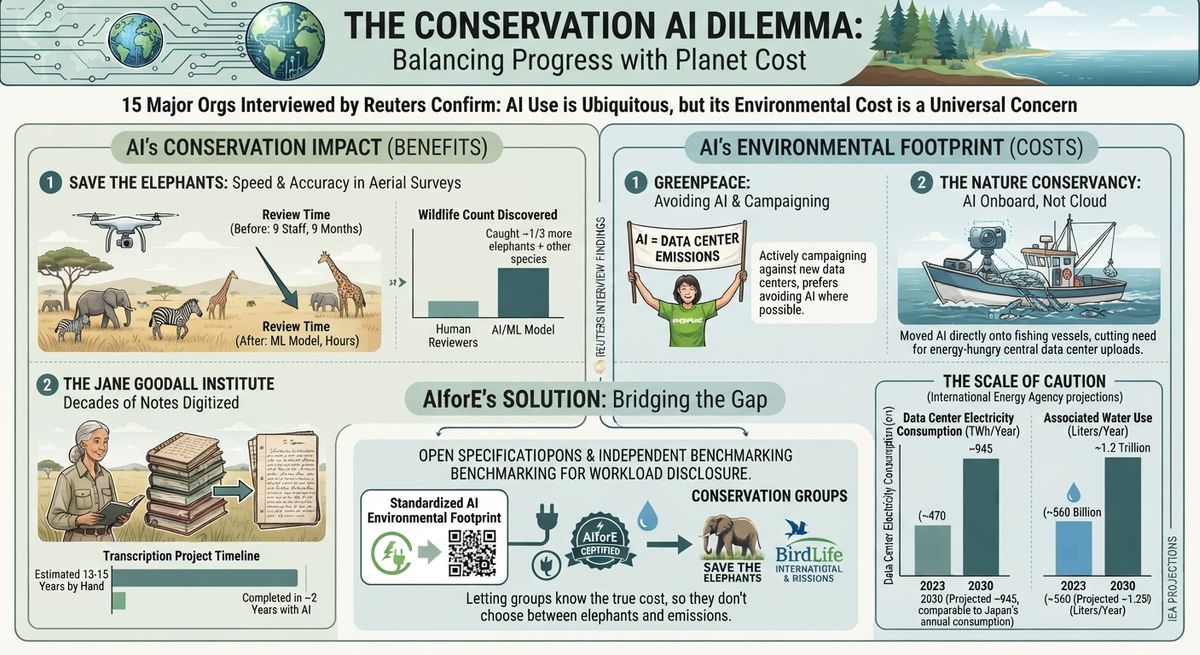
Reuters interviewed 15 major environmental and conservation organizations this week and found a consistent pattern: every one of them uses AI in some form, and every one is wrestling with what that AI costs the planet to run. Save the Elephants now processes aerial wildlife surveys with machine learning models that finish in hours what nine staff once spent nine months reviewing by hand — and the automated counts caught roughly a third more elephants, and far more zebras, giraffes and oryx, than human reviewers had found. The Jane Goodall Institute is using AI to scan, translate and structure decades of handwritten chimpanzee field notes from Tanzania's Gombe National Park, cutting an estimated 13-to-15-year transcription project down to about two.
The same groups are candid about the tradeoffs. Greenpeace said it would rather avoid AI where it can and is actively campaigning against new data center construction. The Nature Conservancy has moved AI-powered cameras directly onto fishing vessels so catch counts can be analyzed onboard, rather than uploading video to energy-hungry central data centers. The scale behind their caution: the International Energy Agency projects data center electricity use could roughly double by 2030 to about 945 terawatt-hours a year, comparable to Japan's entire annual consumption, with associated water use climbing from roughly 560 billion to 1.2 trillion liters a year over the same period.
This is exactly the bind AIforE exists to close. Conservation groups shouldn't have to choose between elephants and emissions, or simply take a vendor's word for what footprint their AI tools carry. Open specifications for disclosing a workload's energy and water draw, backed by independent benchmarking and certification, would let a group like Save the Elephants or BirdLife International know — rather than estimate — the true cost of the tools it depends on, and choose or demand better ones with confidence.
Source: Reuters