Conservation Groups Lean on AI — While Confronting Its Energy Cost
A Reuters survey of 15 conservation groups found all of them use AI — from counting elephants to flagging wildfires — and all are wrestling with the energy and water costs of the data centers behind it.
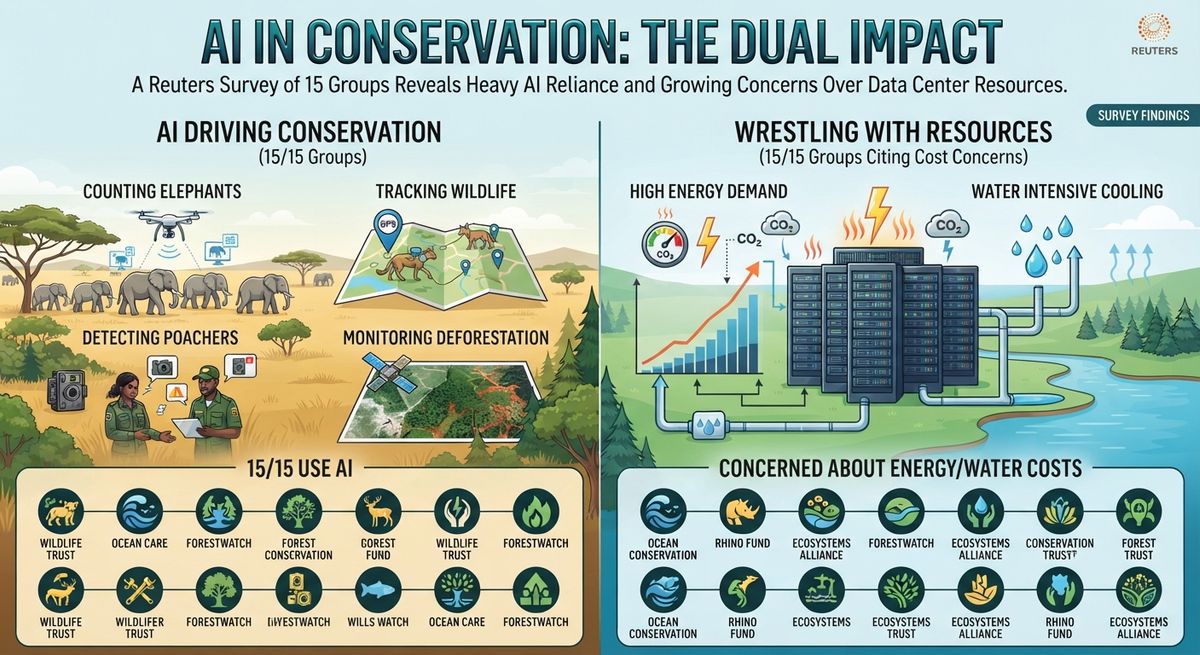
A new Reuters survey of 15 major environmental and conservation organizations found that every one of them is already using AI — and every one is worried about what it costs the planet to run it. Conservation International is using AI to flag satellite-detected wildfire hotspots and alert community forest patrols in Cambodia. In Kenya, Save the Elephants used machine learning to process roughly 200,000 aerial survey images in hours instead of the nine months it used to take, work that revealed human counts had been missing about a third of the region's elephants and far higher shares of zebras, giraffes and oryx. At the Jane Goodall Institute, a tool built with Amazon Web Services is cutting the estimated 13-to-15-year timeline for digitizing decades of handwritten chimpanzee field notes down to about two years.
That progress is arriving alongside real tradeoffs. The International Energy Agency projects data centers' global electricity use will roughly double to about 945 terawatt-hours by 2030 — on par with Japan's annual consumption — while their water use could more than double over the same period. Some groups are already building efficiency into how they use AI rather than waiting for someone else to fix it: the World Resources Institute limits resource-intensive image and video generation and caches repeat queries so identical requests aren't reprocessed, and the Nature Conservancy runs AI on cameras aboard fishing vessels so footage is analyzed at the edge instead of shipped to a centralized data center. Greenpeace takes the most skeptical line of the group, questioning whether the current data center buildout is necessary at all.
This is the exact gap AIforE exists to close. Conservation groups shouldn't each have to independently invent their own caching rules and edge-processing workarounds to keep their AI use honest — they need shared, open benchmarks that make an AI tool's energy, water and carbon footprint as checkable as its accuracy. The practices described here — on-device inference, query caching, limits on the most resource-intensive generation tasks — are exactly the kind of building blocks AIforE wants to document, standardize and certify, so any organization doing good with AI can also show its work on the cost side.
Source: CGTN (Reuters)