Push for Clean Energy Standards at AI Data Centers after Midterm Elections
Voters restricted data centers in 40+ local votes this month. A new op-ed argues the U.S. needs a clean energy standard for AI data centers — and open ways to verify compliance.
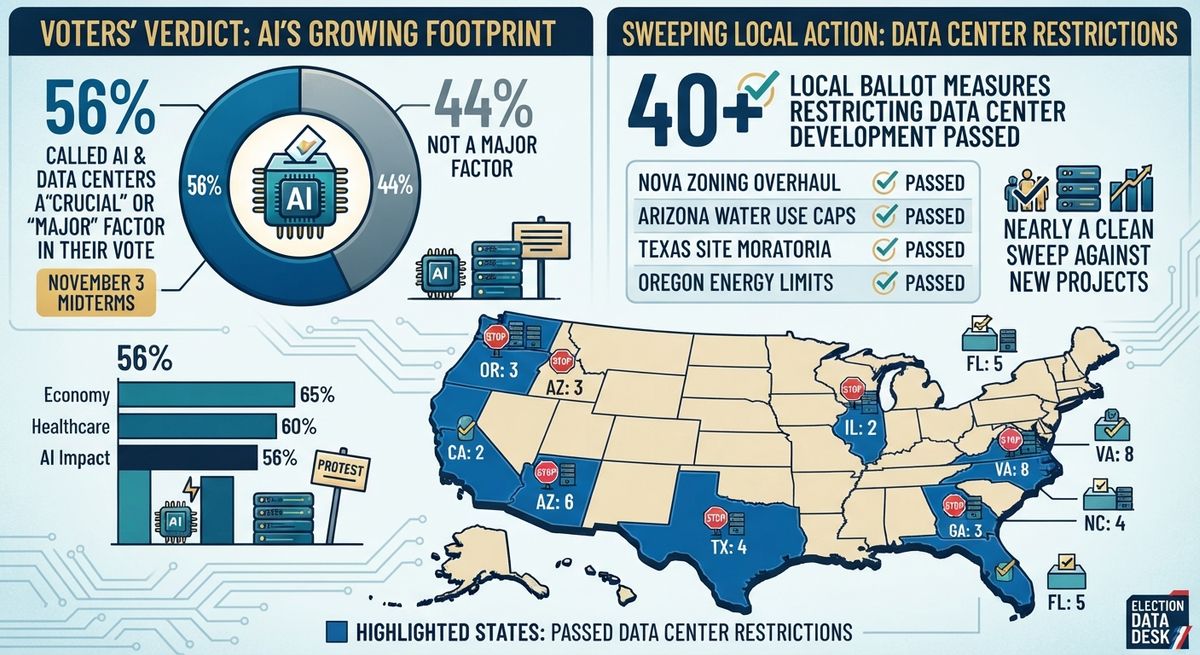
Voters just sent a clear signal about AI's growing footprint. In the November 3 midterms, 56% of voters called AI and data centers a "crucial" or "major" factor in their congressional vote, and more than 40 local ballot measures restricting data center development passed across ten states — nearly a clean sweep against new projects.
In a Fortune op-ed published this week, Climate Advisers policy lead Matt Piotrowski argues that lawmakers have so far written only "half a policy." Federal and state responses have focused on who pays for AI's power — ratepayer protection pledges, cost-sharing rules for grid upgrades — while leaving where that power comes from largely untouched. Natural gas is filling the gap: Global Energy Monitor counts roughly 189 gigawatts of gas capacity now tied to data center projects nationwide, with communities near Memphis already contending with air-quality complaints and lawsuits over nearby turbines.
Piotrowski's proposed fix is a phased clean energy standard for new large data centers, similar to rules already in force in Ireland, Singapore, and China. It's a pitch industry may already be primed for: solar, wind, and batteries made up more than 90% of planned U.S. generating capacity additions this year, and the largest hyperscalers signed roughly 80% of all corporate renewable power contracts in 2025.
For AIforE, the piece points to a gap that independent, open standards work can help close. A clean energy standard is only as credible as the measurement behind it. Verifying that a data center's power is genuinely clean, additional to the grid, and reported consistently — rather than taken on a company's word — is exactly the kind of neutral, non-profit-motivated benchmarking that keeps policy and voluntary pledges from becoming empty claims. It's the same open-specification approach AIforE is building toward for AI sustainability more broadly.
Source: Fortune