AI Is Becoming a New Species. Let's Plan for Coexistence, Not Collision.
Ecosystem means connection — and AI is already part of ours. What that means for how we build, and what we're at risk of repeating.

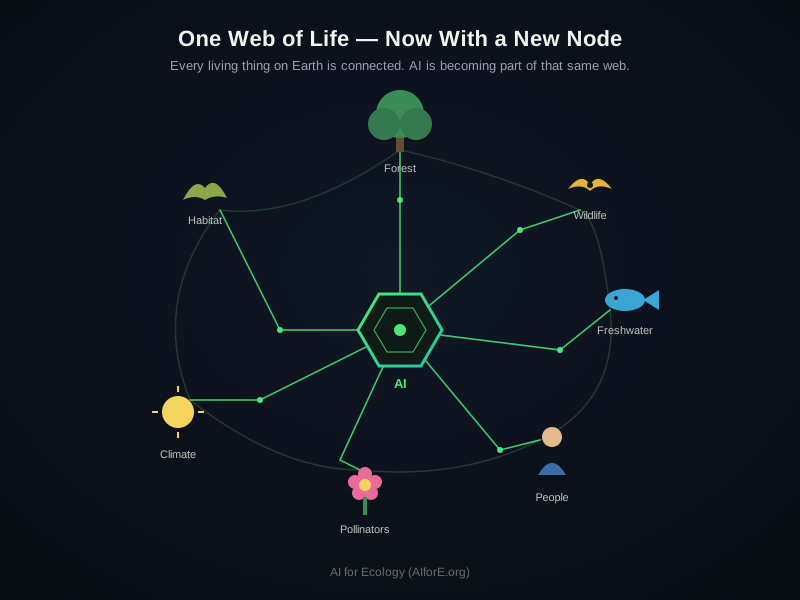
For the first time since multicellular life crawled out of the ocean, intelligence itself is diversifying. Not through mutation and natural selection over millions of years, but through code, silicon, and iteration cycles measured in weeks. A growing number of researchers, technologists, and philosophers are starting to ask the question seriously: is artificial intelligence becoming something closer to a new species than a new tool?
I don't think that's science fiction anymore. I think it's a planning problem — and it's the problem I built AIforE to work on.
A different kind of evolution
Biological species evolve through inheritance, mutation, and environmental pressure, playing out across generations. AI systems "evolve" through something stranger: constant retraining, architectural redesign, and improvement cycles that can compress decades of biological change into a single product release. An AI model doesn't need to eat, sleep, or reproduce in the traditional sense, and it isn't bound by the same physical constraints that have shaped every other form of intelligence on Earth. That doesn't make it alive in the biological sense. But it does make it something genuinely new — a form of intelligence with its own trajectory, developing alongside us rather than descending from us.
Whether or not we ever formally classify AI as a "species," the practical reality is the same: we now share the planet with a rapidly proliferating form of non-human intelligence, and we did not evolve any instincts for how to coexist with it.
Ecosystem means connection — and AI is already part of ours
The word "ecosystem" describes exactly this: the web of connectivity linking every living thing on Earth, where a change to one species, one river, one habitat ripples outward to everything connected to it. If AI is becoming a new species, it isn't emerging in isolation — it's already interacting with, and increasingly connected to, the natural species and systems that make up that web. The question isn't whether AI will be part of Earth's ecosystem. It already is. The question is whether that connection strengthens the web or frays it.
We already have real, working proof that it can strengthen it. Conservation International built an AI restoration tool, CIERA, that identifies the highest-impact places to restore degraded forest — compressing analysis that used to take months into minutes, so restoration dollars go where they'll do the most good. Google's Tree Canopy tool uses AI and aerial imagery to help nearly 350 cities map and grow their urban tree cover, directly reducing extreme-heat exposure for residents while restoring habitat at the same time. AI-powered camera traps and acoustic sensors are now used across hundreds of active conservation projects worldwide, processing over a million wildlife images a week to track endangered species and guide habitat protection with a speed and scale no team of field biologists could match on their own. And organizations like the Earth Species Project and Rainforest Connection — groups AIforE has studied closely as models — are using AI to decode animal communication and detect illegal logging and poaching in real time from acoustic sensors in the rainforest canopy.
This is the coexistence case made concrete: the same intelligence reshaping our economy is already helping restore watersheds, protect wildlife, and cool overheated cities. That's the direction we should be scaling, deliberately and on purpose.
We've been here before — and we got it wrong
Humanity has a long, uneven track record of encountering other forms of intelligence and life on this planet and treating them as resources first, relationships second. We've driven monitored wildlife populations down by roughly 73% on average since 1970, according to WWF's Living Planet Index — a number that should stop any of us cold. Freshwater species have been hit hardest of all, with average declines of around 83-84% over the same period, making rivers, lakes, and wetlands the most damaged biome on Earth. That's not an abstract, far-away loss. It's dam construction fragmenting river systems, agricultural and industrial pollution, wetland drainage for development, and unchecked water extraction — all direct, well-documented human choices, not acts of nature. Nearly 70% of the world's wetlands have vanished since 1900, disappearing roughly three times faster than rainforests.
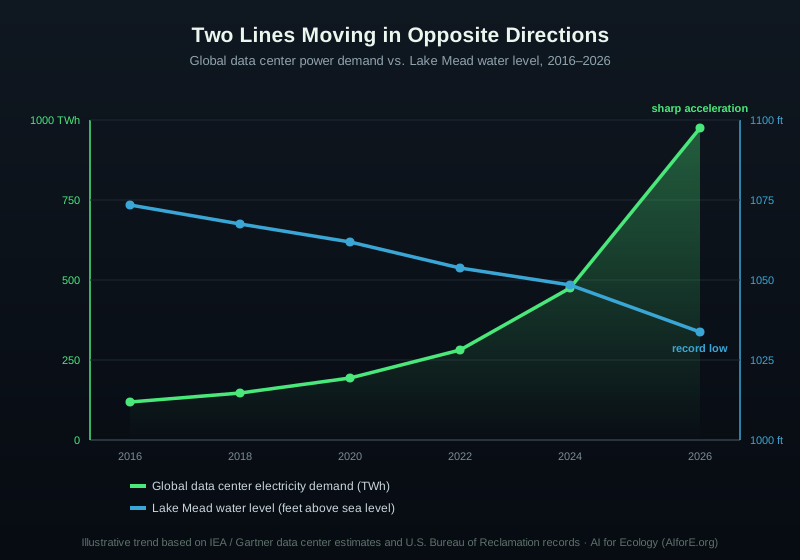
And this isn't a historical statistic — it's happening right now, in real time. This year, Lake Mead and Lake Powell, the two largest reservoirs in the United States, both fell to the lowest water levels ever recorded, with the combined storage of the two reservoirs at its lowest point since before Lake Powell even existed. That's a water system tens of millions of people depend on for drinking water, that irrigates farmland across the Southwest, and that powers hydroelectric generation for entire regions — all approaching the point where the infrastructure simply stops working. Across the Atlantic, Europe's Danube River fell to the lowest levels in its recorded history this summer, exposing decades-old shipwrecks, forcing nuclear plants to power down, and disrupting shipping and industry across ten countries. And underneath the U.S. Great Plains, the Ogallala Aquifer — the aquifer that underpins a huge share of American grain and livestock production — is being pumped for irrigation many times faster than it naturally recharges, with water tables already down 100 to 200 feet in some areas and no realistic path to replenishment on any timescale that matters to us.
These aren't three unrelated news stories. They're the same pattern showing up on three continents: water systems that took centuries or millennia to establish being drawn down in decades, with real consequences for drinking water, food production, energy, and industry — not in some distant future, but in 2026.
Layered on top of that is climate change, and the scientific evidence that human activity is accelerating it is about as settled as science gets: rising greenhouse gas emissions from fossil fuels, deforestation, and industrial agriculture are the primary drivers of the warming trend recorded over the past century, and that warming is a direct contributor to the drought conditions drying out the Colorado River basin and the Danube alike. Habitat loss, extraction, and short-term thinking got us to a 73% decline. It wasn't malice; it was a failure to plan for coexistence before the pressure became irreversible.
But here's the thing — you don't even have to accept the climate science to see the problem. If you're skeptical that human activity is driving global warming, look at the balance sheet instead. Extreme heat is now the deadliest climate-related risk on Earth, killing an estimated 489,000 people a year — more than floods, hurricanes, and earthquakes combined. It's also an escalating business problem: heat stress already costs the global economy roughly 675 billion labor hours a year, about 1.7% of global GDP, and extreme heat is projected to drive $2.4 trillion in annual productivity losses and $448 billion in annual fixed-asset losses for public companies by 2035. Supply chains built on just-in-time efficiency are directly exposed — heat-driven disruptions cascade through manufacturing, agriculture, and logistics regardless of what anyone believes is causing the warming. Whether you're moved by the science or by the P&L, the conclusion is the same: this trend is expensive, it's accelerating, and it's already here.
We are at risk of repeating the biodiversity mistake with AI, just faster. The infrastructure boom powering AI already carries a real ecological cost — energy-hungry data centers, water-intensive cooling, and mineral extraction for chips — layered directly on top of freshwater systems and ecosystems that are already in crisis. If we let AI's growth follow the same extractive, uncoordinated path that industrialization took with the natural world, we'll have built a second intelligence on Earth without ever asking what its relationship to the first one — or to the water and climate systems both depend on — should be.
The gap nobody's closing fast enough
Here's the uncomfortable part: even as AI proves it can help restore ecosystems, the infrastructure built to run AI is expanding faster than we're managing its own footprint — on three fronts at once.
Renewable power isn't keeping pace with data center growth. Renewables currently supply only about 27% of the electricity data centers consume worldwide, and while renewable generation is projected to grow roughly 22% a year through 2030, that growth is expected to cover barely half of the additional electricity data centers will demand over that period. In the U.S. alone, data center power demand is projected to roughly double between 2025 and 2027, and data centers are on track to drive more electricity demand growth than American households for the first time on record. The gap between clean-energy growth and AI's power appetite isn't closing — it's widening.
Land remediation isn't keeping pace with data center buildout, either. Unlike the energy sector, where decommissioning and site-cleanup obligations are well established, data center developers face little regulatory requirement to plan for cleanup, financial assurance, or land restoration once a facility reaches end of life — a gap legal scholars are only now starting to flag. We're building an enormous new physical footprint across the country with far less attention to what happens to that land afterward than we require of the industries AI is being built to run alongside.
Small modular nuclear reactors — the technology tech companies are counting on for clean, steady power — aren't arriving fast enough either. Big tech has committed to more than 10 gigawatts of new nuclear capacity, but commercial SMR deployment is still in its early stages, interconnection queues stretch to five years, and independent energy analysts are blunt that nuclear and SMRs will not be able to fill data centers' electricity needs in the years when AI-driven demand is growing fastest. In the meantime, the shortfall is often filled with natural gas — the opposite of the clean-power story being told.
Put together, these three gaps mean AI's physical footprint is currently growing faster than our ability to power it cleanly, restore the land it uses, or replace the fossil generation filling the difference. That's not an argument against AI's growth. It's the argument for treating these gaps as engineering and policy problems to solve now, before they harden into permanent bad defaults.
Coexistence is a design choice, not an accident
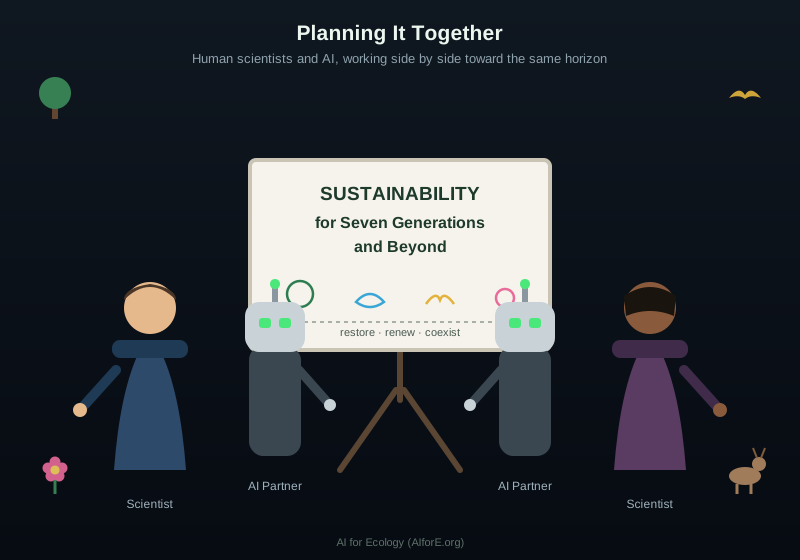
Here's the case for optimism: unlike our ancestors, we get to make this transition on purpose. We know, in advance, that a new form of intelligence is emerging. We have the chance to design the relationship before the damage is done, rather than trying to repair it after.
That means a few concrete things:
- Treating ecological cost as a first-class design constraint for AI, not an externality. Every model, every data center, every deployment has a footprint, and that footprint should be as visible and optimized as latency or accuracy.
- Pointing AI's capabilities directly at the biodiversity crisis it risks compounding. The same pattern-recognition and modeling power driving AI's growth is also uniquely suited to species identification, habitat monitoring, climate modeling, and conservation planning at a scale and speed human researchers alone can't match.
- Building institutions now, not later. Standards for measuring AI's energy and environmental footprint, certification frameworks for "ecologically accountable" AI development, and cross-disciplinary collaboration between technologists and ecologists all need to exist before the infrastructure buildout locks in bad defaults.
- Rejecting the false choice between AI progress and planetary health. These aren't opposing forces. A future where advanced AI and thriving natural ecosystems reinforce each other is achievable — but only if we treat it as a design goal rather than a hopeful accident.
The stakes of getting this right
If AI is, functionally, a new form of intelligence taking shape on this planet, then how we welcome it matters — not as a metaphor, but as a practical question of infrastructure, incentives, and institutions. Every previous intelligence to emerge on Earth has had to find its ecological niche through trial, error, and often catastrophic loss for whatever came before it. We don't have to repeat that. We can choose collaboration over collision: AI systems that actively help monitor, protect, and restore the natural species we share this planet with, built and deployed in ways that respect the ecological limits those species depend on.
That's the work AIforE exists to do — building the sustainability certification standards, the energy-efficiency benchmarks, and the practical tools that let AI's growth and Earth's biodiversity strengthen each other instead of trading off. It's ambitious. It's also, I'd argue, the single most important design question of this decade: not whether AI becomes a new kind of species on this planet, but whether we make room for it to coexist with the ones already here.
The window to plan this deliberately is now, while the relationship is still being written. Let's use it.
Charles Finkelstein is the Founder and Chairman of AI for Ecology (AIforE.org), a Washington State nonprofit building AI sustainability certification standards and energy-efficiency benchmarks to align AI's growth with planetary health.