AI Model Forecasts Wildlife Population Swings Years Before They Happen
IIT Mandi researchers built a self-adaptive AI model that forecasts predator-prey population shifts up to five years out — tested on Isle Royale's wolves and moose, one of the longest wildlife records on Earth.
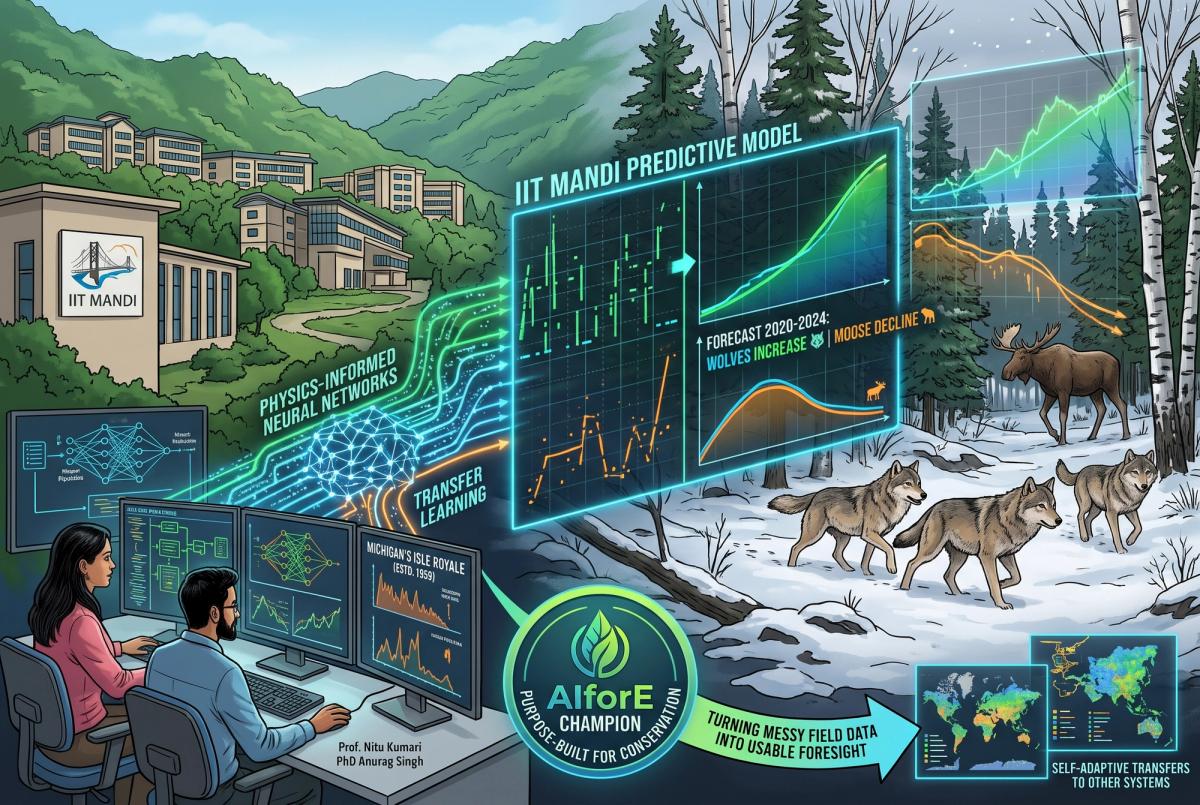
Researchers at India's IIT Mandi have built an AI-powered mathematical model that can forecast shifts in predator and prey populations years before they happen — even when the underlying historical data is incomplete or irregular, which is the norm rather than the exception in long-term ecological monitoring.
The framework, developed by Prof. Nitu Kumari and PhD scholar Anurag Singh, combines physics-informed neural networks with transfer learning to extract patterns from decades of field data. Tested against one of the world's longest-running wildlife records — the wolf and moose populations of Michigan's Isle Royale National Park, tracked annually since 1959 — the model forecast a wolf increase and a moose decline for 2020-2024 that lined up with what was later observed in the park.
AIforE's take: This is a clean example of the kind of AI application our mission exists to champion — not a general-purpose model retrofitted for conservation, but a purpose-built tool that turns messy, decades-old field data into usable foresight for the people managing an ecosystem. The same self-adaptive techniques that make this model work with incomplete records could extend to other predator-prey systems where consistent monitoring has never been possible.
Source: The Newz Radar