AI Dominates Climate Week In NYC
At UN Climate Week, AI's climate promise collided with its rising energy costs. Investment in AI-adjacent climate tech surged 55% even as data-center emissions climbed, making climate change worse — a gap open benchmarks could help close.
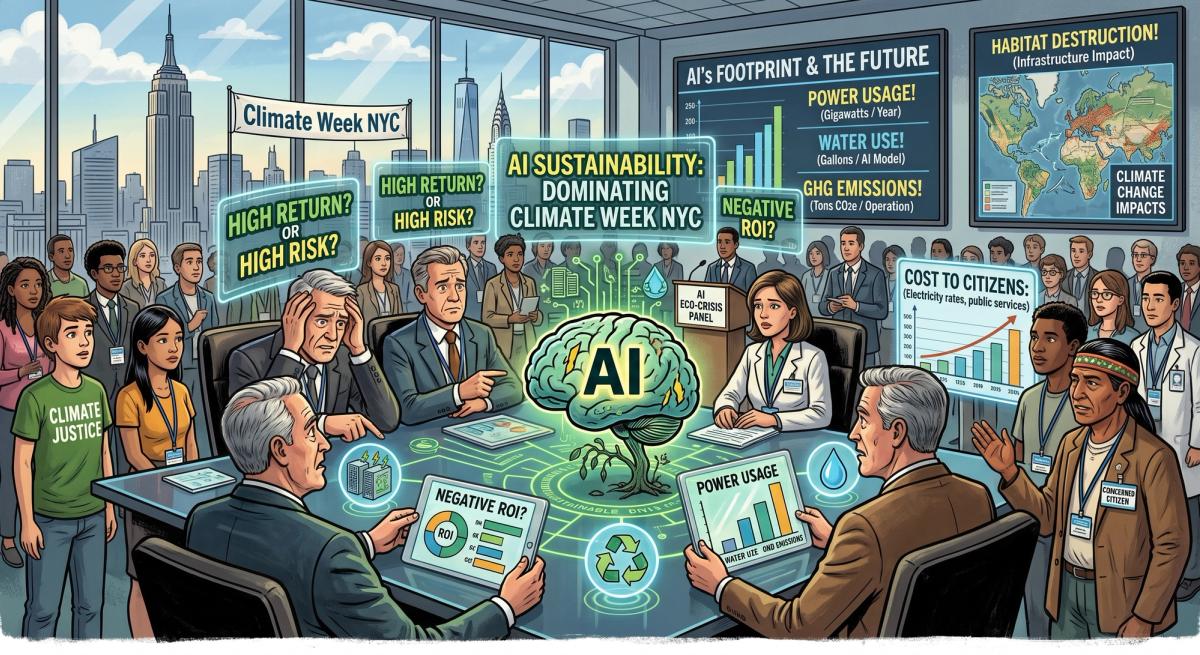
This year's UN Climate Week in New York was dominated by a single question: does artificial intelligence make the climate crisis better or worse? UN Secretary-General António Guterres put it bluntly, warning that AI "could help solve all these challenges, or it could make them worse." Meanwhile UN climate chief Simon Stiell pressed tech companies to justify AI's "skyrocketing costs" as opposition grows near new data center buildouts.
The numbers show both sides of the story. Climate-tech investment jumped 55% year-over-year to $26 billion in the first half of 2026, much of it flowing to data-center-adjacent energy products. But several major tech companies' own emissions rose over the same period, driven largely by AI infrastructure expansion — even as some of that new power still comes from newly built natural gas plants that lock in decades of emissions.
AIforE's take: the debate at Climate Week kept circling back to a problem we work on every day — there's no shared, independently verified way to measure whether a given AI deployment is a net climate positive or negative. Company-reported emissions estimates and vendor sustainability claims aren't a substitute for open specifications and third-party benchmarks. Until the industry adopts common, auditable standards for measuring AI's energy and carbon footprint, "AI could help or AI could hurt" will stay a matter of opinion rather than evidence — which is exactly the gap open certification frameworks are built to close.
Source: MIT Technology Review