AI Boom's New Shortcut: Skip the Grid, Build a Gas Plant Volunteer Accountability
Data center developers are skipping years-long grid queues by building their own gas-fired power plants — a shortcut that could add emissions bigger than the Netherlands' footprint by 2035.

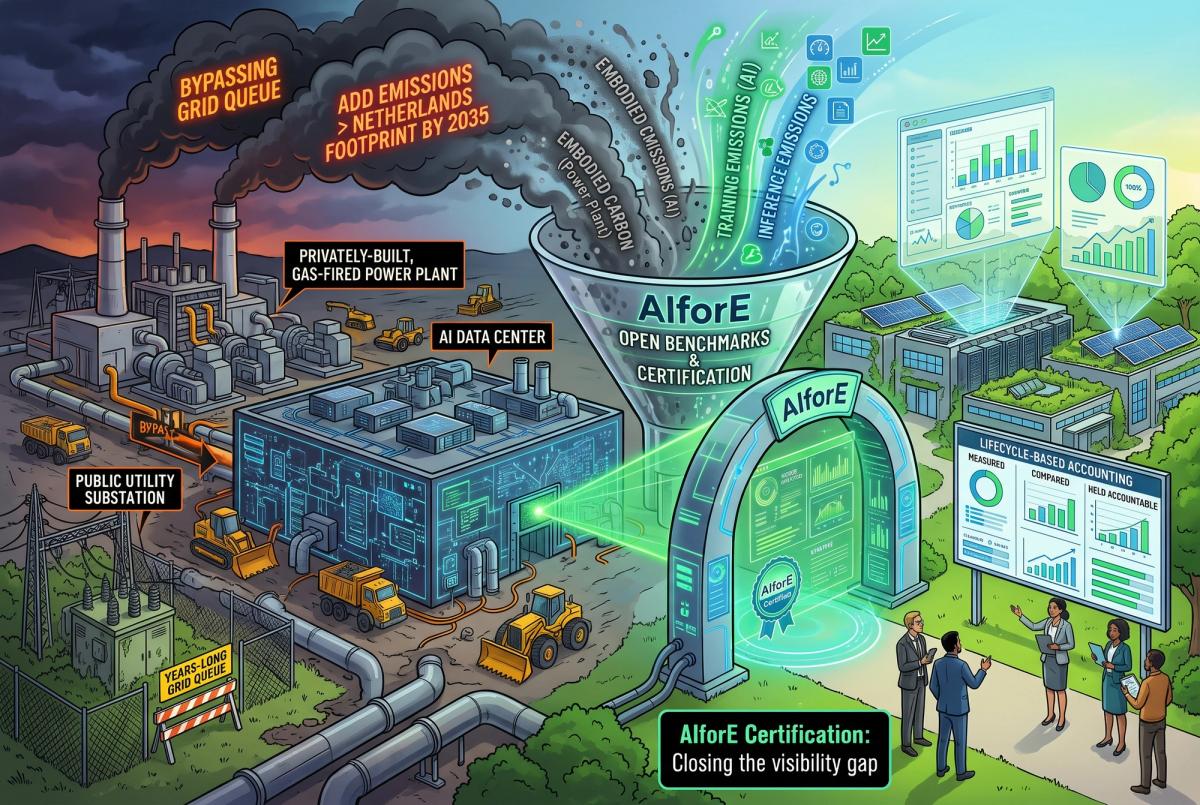
Getting a new data center connected to the electric grid can now take the better part of a decade, so a growing share of developers are skipping the wait entirely and building their own natural gas power plants on-site. More than 100 of these "behind-the-meter" gas projects are now in the pipeline across the US, with a combined planned capacity north of 115 gigawatts — more than double California's peak electricity demand — and nearly all of it has been announced since the start of 2025.
The appeal is speed, not efficiency. Most of these facilities favor cheaper, less-efficient single-cycle turbines over the combined-cycle plants that dominate the regular grid, meaning they're likely to emit more per megawatt-hour than ordinary gas generation — let alone the mix of gas, nuclear, and renewables they're bypassing. Analysts estimate that if every announced project gets built, the added emissions could top 345 million metric tons of CO2-equivalent a year by 2035 compared with drawing the same power from the grid — a gap larger than the Netherlands' entire annual footprint.
What's pitched as a temporary bridge to a future grid connection has a well-documented habit of becoming permanent once the capital is spent on it — the textbook definition of fossil-fuel lock-in.
Why it matters for AIforE: a data center drawing from a clean regional grid and one running its own gas peaker look identical from a press release. Only an independent, lifecycle-based accounting standard — covering training and inference emissions alongside the embodied carbon of the power plant itself — can tell a community, a financier, or a sustainability team which is which. Closing that visibility gap is exactly what AIforE's open benchmarks and certification work are built to do, so "AI infrastructure" stops being a black box and becomes something that can be measured, compared, and held accountable.
Source: MIT Technology Review